
Glossy, Matt or Embossed: Reading a Melamine Surface
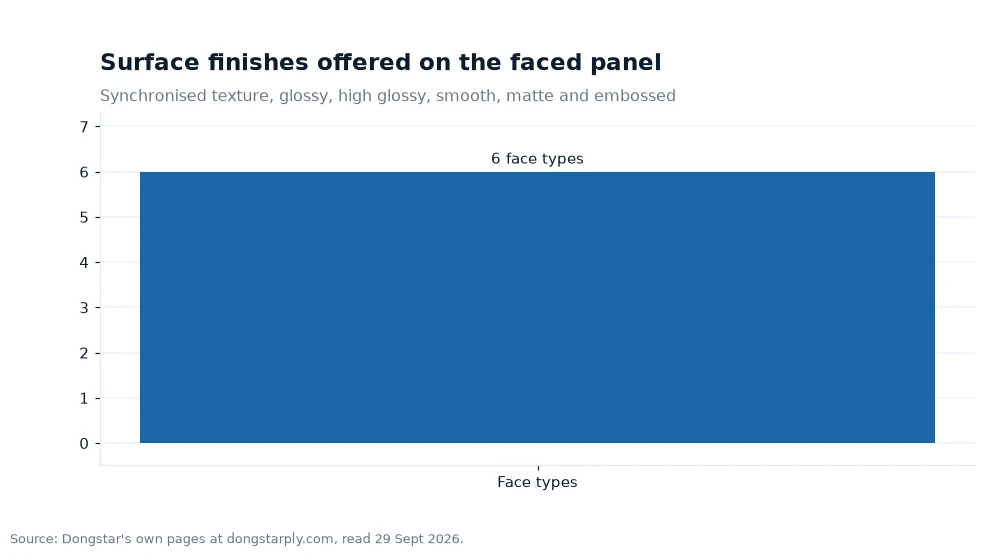
Six face finishes are published for the melamine-faced panel — Synchronized Texture, Glossy, High Glossy, Smooth, Matte and Embossed — on a 1220 × 2440 mm board in 16 mm or 18 mm. Specifying one of them is really a decision about how light behaves on a large flat surface, and how much of the core underneath will show through. The finish name is short; the consequences last as long as the furniture does.
Key takeaways
- Six finishes are listed: Synchronized Texture, Glossy, High Glossy, Smooth, Matte and Embossed, all on the same 1220 × 2440 mm panel.
- The higher the gloss, the flatter the core has to be, because a mirror-like face reflects every wave in the board underneath.
- Textured and embossed faces hide handling marks and core variation, which is why they hold up well in high-contact areas.
- Sampling a finish before the order is the only reliable way to check how a face reads in the light of the room it is made for.
Six names, one underlying question about light
The six names published for Melamine Board are written from the buyer's side of the counter, but they describe physical behaviour. A face either reflects light in a tight, near-mirror direction, or scatters it across a softer angle, or breaks it up with a pattern pressed into the surface. Glossy and High Glossy sit at the mirror end, Matt and Smooth in the middle, and Embossed and Synchronized Texture at the pattern end.
That single axis explains almost every practical difference between the six. Furniture in a brightly lit lobby is judged head-on, so gloss reads as depth and matt reads as flatness. Cabinet fronts in a kitchen are seen at an angle under downlights, where scattered light is kinder to the eye and to the panel. Neither end of the axis is better; they belong to different rooms.
Gloss levels and the core underneath
A gloss face is the most demanding specification on the list for one reason: it shows the substrate. Any ripple in the core, any density variation across the panel, any uneven pressure in the press becomes visible once a reflective film sits on top. That is a manufacturing question as much as a design one, and it is why high-gloss specification usually travels with the flattest core available.
The bond described for this panel is Urea Formaldehyde, and a well-controlled glue line keeps the paper flat against the board. Buyers who want a glossy finish for a large panel should say so early, because core selection is decided long before the decor is applied and cannot be corrected afterwards.
Textured and embossed faces in real rooms
A Synchronized Texture face carries a pattern that aligns with the printed decor beneath it, so the surface has a grain you can feel as well as see. Embossed finishes work on the same principle with a different pattern, and both of them spread reflected light rather than concentrating it. The practical result is a surface that forgives fingerprints, dust and the small marks that any horizontal shelf collects.
They also forgive the panel. Where a gloss face amplifies core variation, a textured face absorbs it, which widens the range of cores that will look right after lamination. For high-traffic commercial work — office storage, retail shelving, reception furniture — that tolerance is worth more than the reflectivity it gives up.
The quiet middle: matt and smooth
Matt and Smooth finishes are the specification most specifiers land on without ever describing why. They reflect enough light to look finished, but diffused enough that incident lighting does not turn a wall of cabinets into a mirror. The surface cleans easily, resists staining and fading as published, and stays visually neutral in rooms with competing materials.
The trade-off is monotony. An all-matt fit-out can read as flat in photographs and in low light, which is why the same projects often mix a textured face into a feature wall or a reception desk. The mix costs nothing in engineering terms, because every finish is offered on the same board format and the same thickness steps.
Sampling before the order is written
Finish selection is the one decision on this panel that cannot be settled from a printed catalogue. A decor that looks warm on a screen can read grey under office lighting, and a gloss that looks elegant in a photograph can show every fingerprint in a family kitchen. Physical samples under the actual lighting of the finished room settle it in an afternoon.
The core decision belongs in the same conversation. Four cores are published for this panel — OSB, MDF, particle board plus hardwood plywood — and each as standard one responds to a face finish differently when it is cut and edged. Choosing the face without naming the core leaves half the specification to chance.
| Finish | Published face type | Behaviour in use |
|---|---|---|
| High Glossy | Listed among the face types | Strong reflection; needs a very flat core |
| Glossy | Listed among the face types | Bright finish for feature fronts and reception areas |
| Matte | Listed among the face types | Neutral under downlights; hides core variation |
| Smooth | Listed among the face types | Easy-clean surface for volume furniture work |
| Synchronized Texture, Embossed | Listed among the face types | Feel and depth; forgiving of marks and dust |
Worked example: one face or two, and what it changes
Take a shop-fitting job with 46 cabinet doors measuring 0.45 m × 0.72 m. Each door front is 0.45 × 0.72 = 0.324 m², so the job needs 46 × 0.324 = 14.9 m² of decorated surface (example arithmetic). One 1220 × 2440 mm panel offers 1.22 × 2.44 = 2.9768 m² per side, and 14.9 ÷ 2.9768 = 5.0 panels — six panels once trimming and grain direction are allowed for (example).
Whether those panels are faced on one side or two changes the number again. A double-faced panel exposes 2 × 2.9768 = 5.9536 m² of decor, so six panels yield 35.7 m² of finished face instead of 17.9 m² (example), which is why carcasses with visible interiors and doors are usually ordered double-faced while shelving that will be covered on the back is not. Paying for decor no one will see is the quietest way to overspend on a fitted interior.
Frequently asked questions
Which finish is hardest to produce?
High Glossy, because it reflects any variation in the core beneath it. Getting the finish right is as much about core flatness and a controlled urea formaldehyde glue line as it is about the decor paper itself.
Do textured faces show fewer marks than matt faces?
They do. A Synchronized Texture or Embossed face scatters reflected light and physically interrupts the surface, so fingerprints, dust and light scuffs read less clearly than they would on a smooth or glossy panel.
Is one finish more durable than another?
Durability comes from the cured surface rather than the pattern. The published description covers wear, scratch and moisture resistance, easy cleaning, and resistance to staining and fading across the range, so the choice is about appearance under light.
Where the specification goes next
Finish is the visible half of this panel, and the core is the half that keeps it flat. Buyers who want to read the structural options behind the decor can compare the fibreboard base board options with the cores listed on the faced panel, then check the panel range as a whole before fixing a specification.
The face finishes, cores and thicknesses described above are lifted from the manufacturer's site, read on 29 September 2026, and taken for this summary, and taken for the chart above[1].