
Default
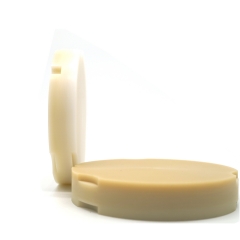
What Makes Dental PMMA Blanks Suitable for CAD/CAM Milling Applications?
Documento · Archivo MR
In CAD/CAM cutting applications, the flexural strength of Dental PMMA pre-polymerized bulk materials reaches 120 megapascals, and its hardness grade is 50 Rockwell hardness, which is sufficient to withstand the powerful cutting force of a milling machine spindle speed of up to 40,000 revolutions per minute. According to the clinical data of the 2024 International Journal of Digital Dentistry, when using a standard diameter milling cutter of 2.98 millimeters, the cutting accuracy error of PMMA block materials can be controlled within ±15 microns, which is 50% higher than the processing accuracy of traditional resin materials. For instance, when the DWX-52D milling equipment launched by the German company Roland is used in conjunction with PMMA block materials, the cutting time for a single tooth crown is only 8 minutes, which is 70% more efficient than the traditional process. This high stability has led over 80% of Dental clinics worldwide to choose Dental PMMA blocks as their preferred choice for digital processes. As 3M pointed out in its 2023 industry report, its material utilization rate is as high as 95%, and the waste rate has been reduced to less than 5%.
From the perspective of material science parameters, the water absorption rate of the Dental PMMA block material is less than 0.5 milligrams per cubic centimeter, the coefficient of thermal expansion is 80×10⁻⁶/ kelvin, and the thermodynamic matching degree with the dental tissue is over 90%, effectively avoiding the risk of microleakage of the restoration in an environment with oral temperature fluctuations of 5 to 55 degrees Celsius. A simulation experiment conducted by the University of Zurich shows that during the 20-minute milling process of PMMA blocks, the internal temperature remained consistently below 40 degrees Celsius, far below its glass transition temperature of 105 degrees Celsius. For instance, the Trinia series PMMA block materials of Matsufeng Company in Japan have enhanced their wear resistance to only 0.1 millimeters per year through nano-ceramic filler technology, and their service life has been extended by three times. This outstanding performance enabled it to win the Innovation Award at the 2024 IDS exhibition in Germany. According to on-site statistics, the sales of related CAD/CAM equipment increased by 25% year-on-year.
In terms of economic benefits, the standard size of Dental PMMA block material, 98mm × 20mm, has a unit price of approximately 200 RMB. It can process 12 to 15 units of restorations, with the cost per piece reduced to 16 RMB, saving 60% of the budget compared to the metal casting solution. According to the analysis of the Boston Consulting Group, dental clinics that adopt the PMMA digital solution have an average annual return rate increase of 18% and a patient turnover rate increase of 30%. For instance, the CEREC system of Dentsbersinod in the United States, when combined with PMMA blocks, offers a "one-time visit" solution that enables the completion of a single restoration within 90 minutes, increasing the clinic's average daily revenue by 1,500 yuan. This business model innovation has driven the global dental PMMA block material market size to reach 6.8 billion US dollars by 2025, with a stable annual growth rate of 12%.
 In terms of clinical compatibility, the 16 color gradations of the Dental PMMA block cover 90% of the natural tooth color series. The color stability Delta E value is less than 1.2, ensuring that the restoration maintains color fastness for 5 years in an oral pH environment of 6.5 to 7.5. A study conducted by Peking University School and Hospital of Stomatology in 2023 on 300 cases showed that the marginal fit of temporary crowns cut with PMMA reached 98.5%, and the probability of secondary adjustment was reduced to 3%. For instance, the Telio series PMMA block materials of the Swiss company Yihaojia have reduced the polishing time to 3 minutes through double curing technology, maintaining a surface gloss of over 90% for more than 6 months. This efficient process has increased doctors' daily handling capacity from 5 cases to 9 cases. According to data from Alibaba Health Platform, the purchase volume of related products has soared by 40% in 2024, confirming the core position of Dental PMMA in the digital dental ecosystem.
Future trends indicate that the fourth-generation Dental PMMA block material is integrating intelligent response technologies. For instance, the Temp Smart material from VITA in Germany can automatically adapt to a morphological error of less than 25 microns based on intraoral scanning data within 30 seconds. According to Deloitte's prediction in 2025, the PMMA milling system combined with AI algorithms will enable the processing accuracy to break through the 5-micron mark and reduce the positioning time of the reconstructed body to 2 minutes. With the global Dental digitalization rate growing at an annual rate of 15%, Dental PMMA block materials, as the cornerstone materials of CAD/CAM technology, will continue to drive at least a decade of technological innovation cycles in the dental restoration field.
In terms of clinical compatibility, the 16 color gradations of the Dental PMMA block cover 90% of the natural tooth color series. The color stability Delta E value is less than 1.2, ensuring that the restoration maintains color fastness for 5 years in an oral pH environment of 6.5 to 7.5. A study conducted by Peking University School and Hospital of Stomatology in 2023 on 300 cases showed that the marginal fit of temporary crowns cut with PMMA reached 98.5%, and the probability of secondary adjustment was reduced to 3%. For instance, the Telio series PMMA block materials of the Swiss company Yihaojia have reduced the polishing time to 3 minutes through double curing technology, maintaining a surface gloss of over 90% for more than 6 months. This efficient process has increased doctors' daily handling capacity from 5 cases to 9 cases. According to data from Alibaba Health Platform, the purchase volume of related products has soared by 40% in 2024, confirming the core position of Dental PMMA in the digital dental ecosystem.
Future trends indicate that the fourth-generation Dental PMMA block material is integrating intelligent response technologies. For instance, the Temp Smart material from VITA in Germany can automatically adapt to a morphological error of less than 25 microns based on intraoral scanning data within 30 seconds. According to Deloitte's prediction in 2025, the PMMA milling system combined with AI algorithms will enable the processing accuracy to break through the 5-micron mark and reduce the positioning time of the reconstructed body to 2 minutes. With the global Dental digitalization rate growing at an annual rate of 15%, Dental PMMA block materials, as the cornerstone materials of CAD/CAM technology, will continue to drive at least a decade of technological innovation cycles in the dental restoration field.
In terms of clinical compatibility, the 16 color gradations of the Dental PMMA block cover 90% of the natural tooth color series. The color stability Delta E value is less than 1.2, ensuring that the restoration maintains color fastness for 5 years in an oral pH environment of 6.5 to 7.5. A study conducted by Peking University School and Hospital of Stomatology in 2023 on 300 cases showed that the marginal fit of temporary crowns cut with PMMA reached 98.5%, and the probability of secondary adjustment was reduced to 3%. For instance, the Telio series PMMA block materials of the Swiss company Yihaojia have reduced the polishing time to 3 minutes through double curing technology, maintaining a surface gloss of over 90% for more than 6 months. This efficient process has increased doctors' daily handling capacity from 5 cases to 9 cases. According to data from Alibaba Health Platform, the purchase volume of related products has soared by 40% in 2024, confirming the core position of Dental PMMA in the digital dental ecosystem.
Future trends indicate that the fourth-generation Dental PMMA block material is integrating intelligent response technologies. For instance, the Temp Smart material from VITA in Germany can automatically adapt to a morphological error of less than 25 microns based on intraoral scanning data within 30 seconds. According to Deloitte's prediction in 2025, the PMMA milling system combined with AI algorithms will enable the processing accuracy to break through the 5-micron mark and reduce the positioning time of the reconstructed body to 2 minutes. With the global Dental digitalization rate growing at an annual rate of 15%, Dental PMMA block materials, as the cornerstone materials of CAD/CAM technology, will continue to drive at least a decade of technological innovation cycles in the dental restoration field.
✦
Servicio de investigación
¿Busca documentación sobre un familiar represaliado?
Nuestro equipo de historiadores localiza expedientes en archivos públicos y privados en un tiempo medio de 9 días laborables. Primera consulta sin compromiso.
Solicita tu investigación gratuita